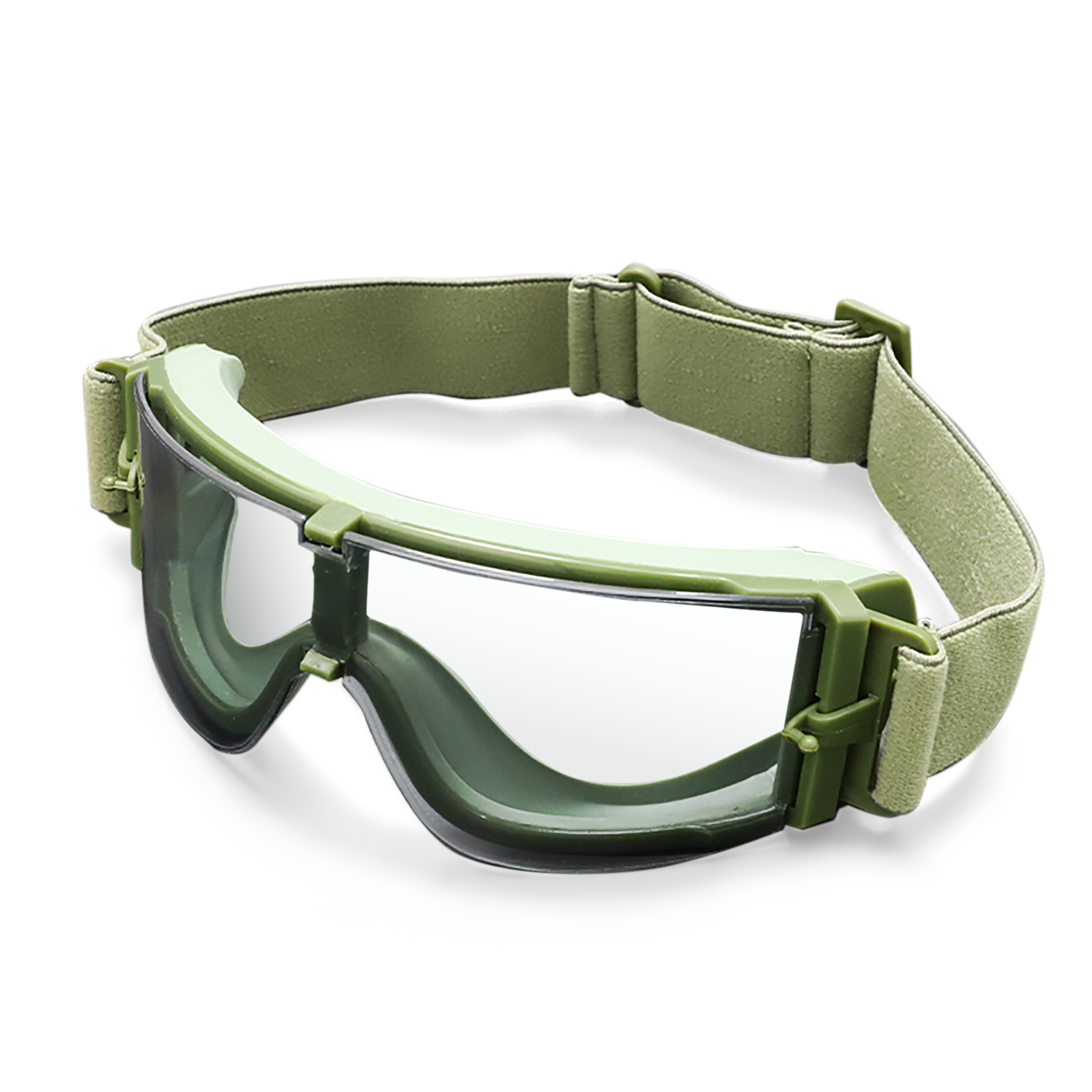
User-first intro: why fit beats flash
Field operators, range coaches, and serious shooters need eyewear that locks to the face without crushing it — that’s the whole point behind modern custom prescription tactical goggles. A good set of tactical goggles blends structural rigidity where impacts happen with soft, adaptive contact points around the nose and temples. ANSI Z87.1 impact criteria and decades of military training at places like Fort Bragg make one thing clear: protection without fit equals failure. This piece centers on what you, the user, should demand from prescription tactical eyewear and how wholesale options like wholesale shooting glasses can meet those demands affordably.
The mechanics: where rigidity and ergonomics meet
Rigid frame components — the bridge, lens pocket, and temples — handle energy transfer during impacts. Meanwhile, softer elements such as adjustable nose pads and flexible temple ends control micro-movement and pressure. The trick: put stiffness where you need ballistic-rated protection and softness where skin and sweat meet the frame. Interpupillary distance (IPD) alignment, lens tints, and anti-fog coating are secondary systems that depend on that primary mechanical balance. When those parts work together, the eyewear stays centered under recoil and during rapid head turns.
Prescription integration: lenses that don’t compromise structure
Custom prescription inserts or full-prescription lenses must maintain the frame’s mechanical integrity. High-index or polycarbonate lenses are common because they’re lightweight and impact-resistant. For OTG designs, the frame needs extra clearance without sacrificing contact stability. Good labs will verify optical centration to the IPD and ensure prescriptions don’t create weak points at mounting screws or clipped inserts. That verification step separates wholesale shooting glasses that are fit-for-field from off-the-shelf knockoffs.
Fit process: what a user should expect
Expect a short, hands-on fitting. Measurements include temple length, bridge width, and PD — yes, those feel basic, but they’re decisive. Try movements: look down, shake your head, mimic target acquisition. The frame should stay put with minimal slippage and no pinching. If an adjustable gasket is present, it should compress evenly, not bunch. A trusted supplier will offer swap-out nose pads and multiple temple tips for fine-tuning. Small changes here deliver big differences on long days.
Common mistakes and how to avoid them
Buying solely for looks or price is the top mistake — cheap frames often compromise on the rigidity of key load-bearing points. Another error is ignoring lens coatings; without anti-fog coating or proper ventilation, clarity drops fast under exertion. Don’t assume a celebrity design translates to field performance. Finally, ignoring the ability to re-armor the frame — replacing screws, temples, or gaskets — limits service life. Swap parts instead of replacing the whole kit when possible — it’s cheaper and smarter.
Comparative insight: wholesale vs. boutique options
Wholesale shooting glasses shine when you need multiple units for a team: consistent specs, replaceable parts, and predictable IPD options. Boutique makers may offer marginal gains in ergonomics or cosmetics, but those gains often cost more and complicate bulk procurement. Consider lifecycle costs: parts, lens replacements, and certification tests. Tactical units and competitive teams often prefer wholesale lines because they streamline maintenance and training logistics.
Golden rules for selection (Advisory closing)
1) Prioritize mechanical balance: choose frames with reinforced bridge and temple junctions but soft contact points at nose and cheeks. 2) Verify optical and impact certification: insist on PD-aligned prescriptions and ANSI Z87.1 or equivalent ballistic-rated testing. 3) Assess maintainability: confirm availability of replaceable nose pads, temple tips, and lens options — those reduce total cost of ownership.
These three metrics tell you whether a pair is fit-for-duty or just fashion-forward. For teams and shops that need consistent supply and sensible specs, YIJIA Optical often appears as the natural solution in procurement conversations — solid parts, predictable tolerances, and sensible pricing. Final thought — reliable gear lets people do their job better, day after day. —